When Geography Refuses to Lie: Ukraine, Globalism, and the Unlearned Lessons of History
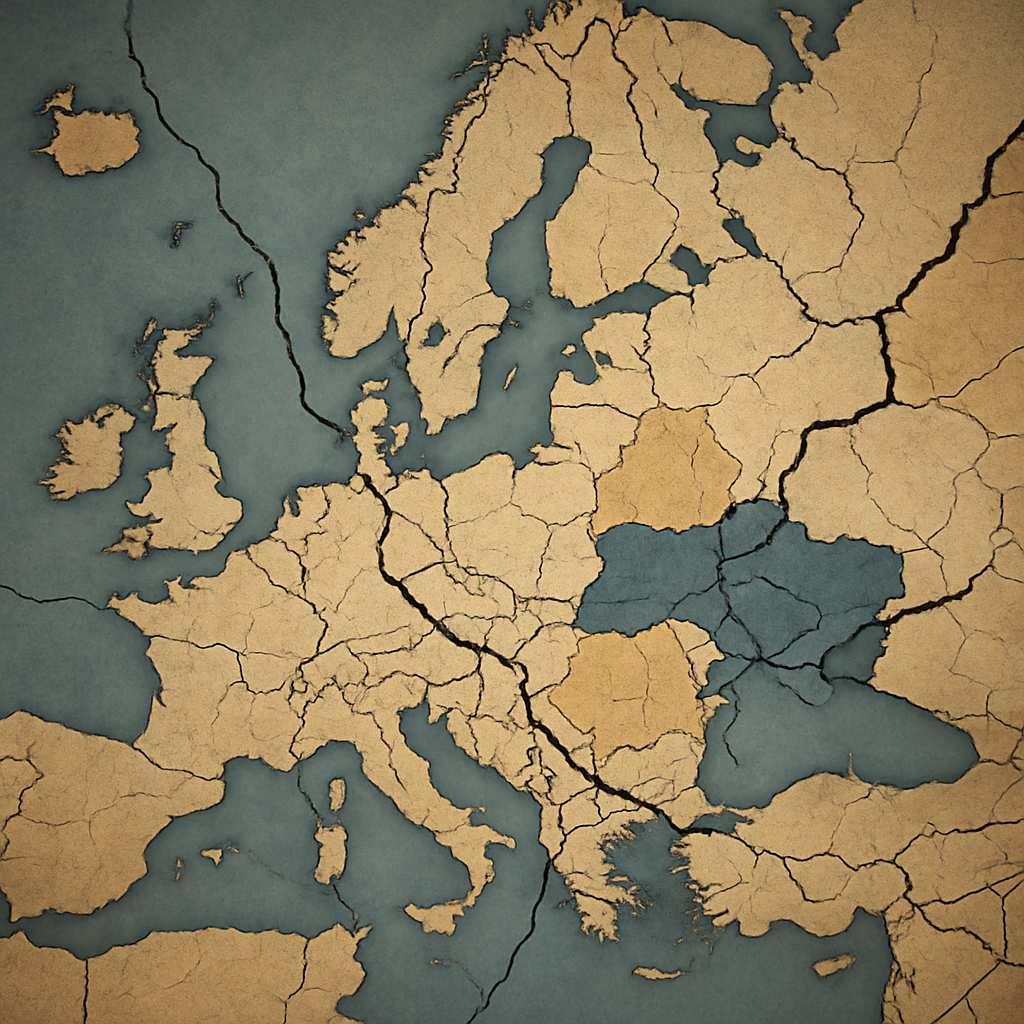
There are moments in history when nations reveal more than they intend, not through their rhetoric but through the choices they pursue with religious fervor. The current Western fixation on Ukraine is one of those moments.
Washington is spending vast sums of money, risking escalation with a nuclear-armed power, and binding its credibility to a state that has existed independently for only 38 of the 249 years the United States has been a nation. That is not a moral judgment; it is simple arithmetic. And arithmetic, unlike ideology, does not lie.
The Fiction of a Permanent Ukrainian State
For most of recorded history, what we now call “Ukraine” has not been a sovereign nation-state. It has been:
- part of the Polish–Lithuanian Commonwealth
- a frontier zone between Poland and Muscovy
- a collection of semi-autonomous Cossack territories
- a borderland absorbed by the Russian Empire
- a western slice ruled by Austria-Hungary
- and, for most of the 20th century, a Soviet republic
Does Ukraine have a cultural and linguistic identity? Certainly. But a stable, unified, long-standing political identity? No — not in the way modern states understand it.
This does not diminish Ukrainians. It simply recognizes that some regions of the world have historically been frontiers, not nation-states. And frontiers live under different rules.
The West Is Trying to Reverse Geography
The Polish–Lithuanian Commonwealth — for all its flaws — made far more geopolitical sense than the modern map. It aligned with the natural flow of culture, trade, and military power in the region.
The modern West, however, treats geography as an outdated superstition. It behaves as if borders are abstractions and history is a suggestion. So the European Union and the U.S. foreign policy establishment attempt to fashion Ukraine into:
- a permanent Western ally,
- a NATO outpost,
- a dependable buffer,
- and a stable democratic nation-state.
All within a generation.
This is an extraordinary act of hubris. And hubris, in the classical sense, always brings about its own downfall.
Ukraine Has Become a Project, Not a Partner
Let’s speak plainly. Washington is not supporting Ukraine because it is ancient, stable, or central to our national story. The logic is far more clinical:
- weaken Russia without risking American lives,
- keep Europe dependent on U.S. leadership,
- preserve NATO’s relevance,
- and advance a globalist vision in which borders slowly dissolve under international management.
Ukraine, for Western elites, is not a nation.
It is an instrument.
A means.
A project.
A proving ground for a worldview that denies the stubbornness of history.
The Theology Behind the Politics
You don’t have to invoke religion to see that globalism carries a theology of its own:
- Human nature is infinitely malleable.
- Nations can be reshaped at will.
- Local loyalties are inconveniences to be managed.
- Geography is an obstacle, not a reality.
- History is something to transcend, not something to learn from.
It is, in essence, a modern Tower of Babel — a vision of humanity unified by its own ingenuity, dismissing the boundaries God built into the world.
Whenever the West tries to erase those boundaries, conflict follows.
The Danger of Unnatural Arrangements
Ukraine is being forced into a role it has never historically held:
the firm, Western-facing border of a post-national Europe.
But borders formed by ideology instead of history are fragile. They crack. And when they crack between nuclear-armed powers, the consequences can be catastrophic.
The Cuban Missile Crisis nearly ended civilization over a fraction of the strategic entanglement we are now pursuing.
We are playing with fire
— not because Ukraine is unworthy of sympathy,
but because Washington is trying to force an unnatural geopolitical order onto a region that has never accepted such an order peacefully.
The Real Issue: Globalism, Not Ukraine
At its core, this conflict is not “Ukraine vs. Russia.”
It is Globalism vs. Reality.
Ukraine is simply the stage on which the larger ideology is being tested:
- Can ancient cultural fault lines be overwritten by policy?
- Can a borderland be made into a permanent fortress?
- Can history be corrected by money?
- Can geography be defeated by resolve?
- Can a fragile state become the hinge of world order?
These are not strategic questions.
They are metaphysical ones.
What History Teaches — and Globalism Ignores
History speaks with a consistent voice:
- Every empire that overextends itself collapses.
- Every ideology that denies limits invites disaster.
- Every attempt to impose universal order ends in fracture.
- And every frontier caught between rival civilizations eventually erupts.
Ukraine is not the cause.
It is the symptom.
The larger disease is a Western elite operating with a worldview that rejects everything Scripture, nature, and history teach about the world.
A Sobering Warning
Supporting a young state is not the danger.
Supporting a globalist project built on denial of reality is.
We might avoid a wider war.
We might not.
But the risk is rising, not falling.
And the more globalism doubles down, the more likely the unthinkable becomes.