TEKEL and the Hollow Age: Why Our Civilization Is Being Weighed and Found Wanting
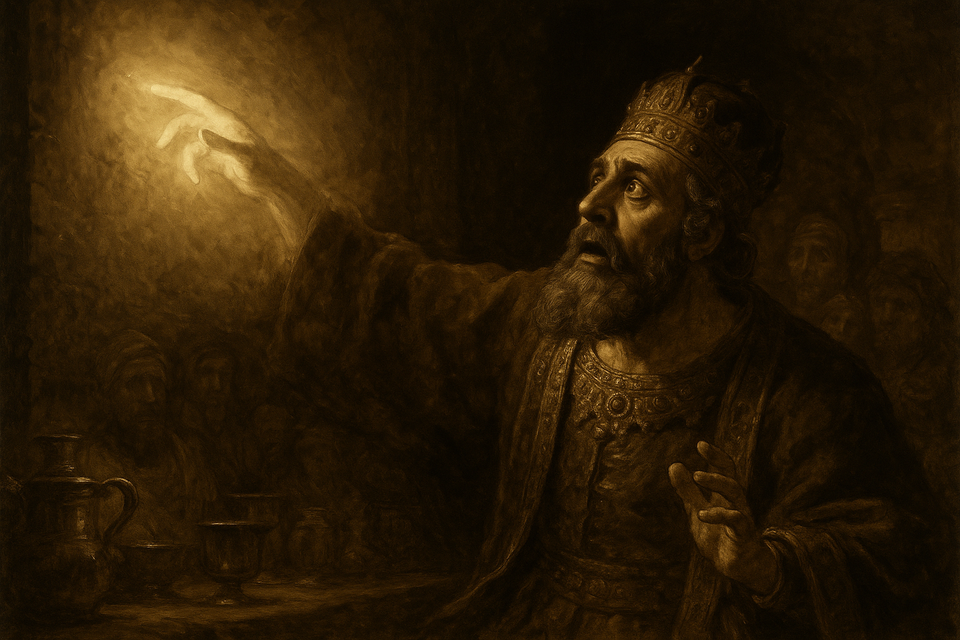
The handwriting on the wall remains one of the most unsettling images in Scripture. During Belshazzar’s great feast—an event lavish and irreverent even by ancient standards—divine fingers appear and carve a message into the plaster: MENE, MENE, TEKEL, UPHARSIN.
The fall of Babylon that very night is dramatic, but the true weight of the episode lies in the second word: TEKEL.
“You have been weighed in the balances, and found wanting.”
This judgment is not merely ancient history. It is a permanent pattern.
Kings are weighed.
Churches are weighed.
Nations are weighed.
Civilizations are weighed.
And when their inner substance collapses, the verdict is always the same.
The tragedy of Belshazzar is not that he died suddenly—it is that he had been hollow long before the handwriting appeared.
The Hollow King and the Hollow Age
Belshazzar’s feast takes place on the night Babylon is surrounded by enemies. It is an act of denial, a refusal to reckon with the truth. He summons the sacred vessels from the Temple in Jerusalem, profanes them, praises idols of gold and silver, and loses his kingdom before the night is over.
Archaeological and historical sources paint late Babylon in similar terms: a powerful empire whose cultural elite had become detached, indulgent, and frivolous. Its political class was insulated from the real pressures pressing upon the empire; its religious life was ceremonial rather than sincere.
What Daniel presents, then, is not simply a debauched king but an entire civilization that has lost its gravity.
And in this, Babylon becomes a mirror for the West.
We are wealthy, technologically advanced, creative, and globally influential. Yet beneath the surface lies a growing hollowness—a loss of meaning, a decline of virtue, a collapse of shared purpose, and a profound forgetfulness of the sacred. Our public life has become a performance without substance, a feast held in the shadow of crumbling walls.
We have become Babylon with electricity.
The Loss of Weight
In biblical language, glory—kavod—means weight, substance, reality.
To have glory is to have something solid in one’s being.
To lack glory is to become light, trivial, insubstantial.
When God weighs Belshazzar, He finds him lacking this essential substance.
Civilizations follow the same pattern.
- They rise through discipline, sacrifice, and awe.
- They stabilize through order, meaning, and reverence.
- They decline through luxury, amnesia, and self-worship.
- They collapse when the hollow center can no longer support the glittering shell.
Babylon had reached the final stage. Increasingly, so have we.
The Four Marks of a “Wanting” Civilization
Daniel’s critique of Belshazzar offers a framework for diagnosing civilizational decline.
1. Profaning the Sacred
Belshazzar’s core sin is desecrating the holy.
He treats what is consecrated as entertainment.
Modern society acts likewise:
- Marriage is redefined into therapy.
- Sex becomes entertainment.
- Worship becomes performance.
- Human bodies become canvases for ideology.
- The image of God becomes a negotiation rather than a given.
A society that trivializes sacred realities loses the moral boundaries that hold it together.
2. Forgetting History
Daniel rebukes Belshazzar: “You knew all this.”
He had witnessed God’s dealings with Nebuchadnezzar but refused to learn.
Our civilization likewise imagines itself the first age—modern man freed from the constraints of the past. We dismantle monuments, rewrite history, and dismiss the accumulated wisdom of centuries as bigotry or superstition.
A civilization that forgets its story loses the meaning that sustains it.
3. Idolatry of the Material
Belshazzar praised gods of gold and silver.
Our idols are more sophisticated, but no less material:
- Consumerism
- Technology
- Wealth
- Comfort
- Celebrity
- Political identity
We still bow—only the temples have screens.
4. False Security Amid Crises
Belshazzar feasted while his empire collapsed.
Likewise, the modern West faces:
- demographic decline
- economic fragility
- widespread mental illness
- collapsing social institutions
- rising geopolitical threats
Yet the cultural mood is one of distraction rather than seriousness.
The revelry continues while the walls crack.
A Covenantal Anthropology: Why Hollow Civilizations Collapse
The verdict on Belshazzar is not merely moral but anthropological. When he is weighed and found wanting, it is his very substance that proves deficient. Scripture portrays human dignity, strength, and meaning as gifts received from God—a reality that imparts stability and weight to human life.
To lose this grounding is to become spiritually weightless.
This is the deeper meaning of Tekel: individuals or societies can lose the substance that comes from living in right relation to the God who grants being and purpose. When that relation ruptures—when man becomes self-invented rather than God-given—civilizations begin to hollow out from the inside.
Such societies cannot withstand their own pressures. They lose coherence, purpose, and moral gravity. They unravel not because of external invasion but because of internal emptiness.
A world that detaches humanity from its divine source becomes a world of vapor.
And vapor cannot bear the weight of a civilization.
The Political and Cultural Implications
Daniel 5 is a political parable. It reflects timeless truths:
- Nations are morally accountable.
- Leadership is a stewardship before God.
- Power is never absolute; it is loaned.
- Societies do not fall merely from conquest—they collapse from internal decay.
Toynbee observed that civilizations die when their “creative minority” abandons virtue and indulges in decadence. Belshazzar is the archetype of such leadership. And when leaders become hollow, the institutions they preside over soon follow.
In our own context, the signs are unmistakable:
- Declining trust in institutions
- Corruption and cynicism in public life
- Polarization without principle
- An elite class increasingly detached from ordinary life
- A culture of spectacle masking moral emptiness
These are not accidents. They are symptoms of a civilization losing its weight.
Is There a Way Back?
Daniel 5 offers no redemption for Babylon; its judgment is irreversible. But the biblical witness as a whole offers a path of renewal for societies willing to heed the warning.
Civilizations regain weight by recovering what gives human life substance:
- Reverence for the sacred
- Truth as objective rather than constructed
- Strong families anchored in stability and covenant
- Moral leadership grounded in accountability before God
- A renewed sense of human dignity rooted in creation, not ideology
- Communities formed around responsibility rather than indulgence
Civilizations do not regenerate through policy alone. Renewal begins with anthropology—with recovering the truth about who man is.
A civilization that begins to fear the Lord regains its gravity.
A civilization that refuses eventually collapses under its own hollowness.
The Handwriting on Our Wall
Our handwriting is not on plaster. It is written in:
- demographic implosion
- institutional decay
- epidemic loneliness
- loss of meaning
- cultural fragmentation
- eroding social trust
- geopolitical volatility
These phenomena are not merely indicators; they are warnings.
The scales are being set upon the table.
Whether our civilization will recover weight or collapse like Babylon remains uncertain. But the pattern is clear, and the verdict is not predetermined. What is required is not nostalgia, but repentance—not sentiment, but substance—not reinvention, but return.
Belshazzar died in a night.
Civilizations may take longer.
But the principle is immutable:
Those who lose their weight will be weighed.
Those who are weighed will be judged.
And only those grounded in the eternal can stand.